Lift gas
Distribute lift gas across wells where it produces the strongest production result.
 Process Optimization
Oil and gas production optimization
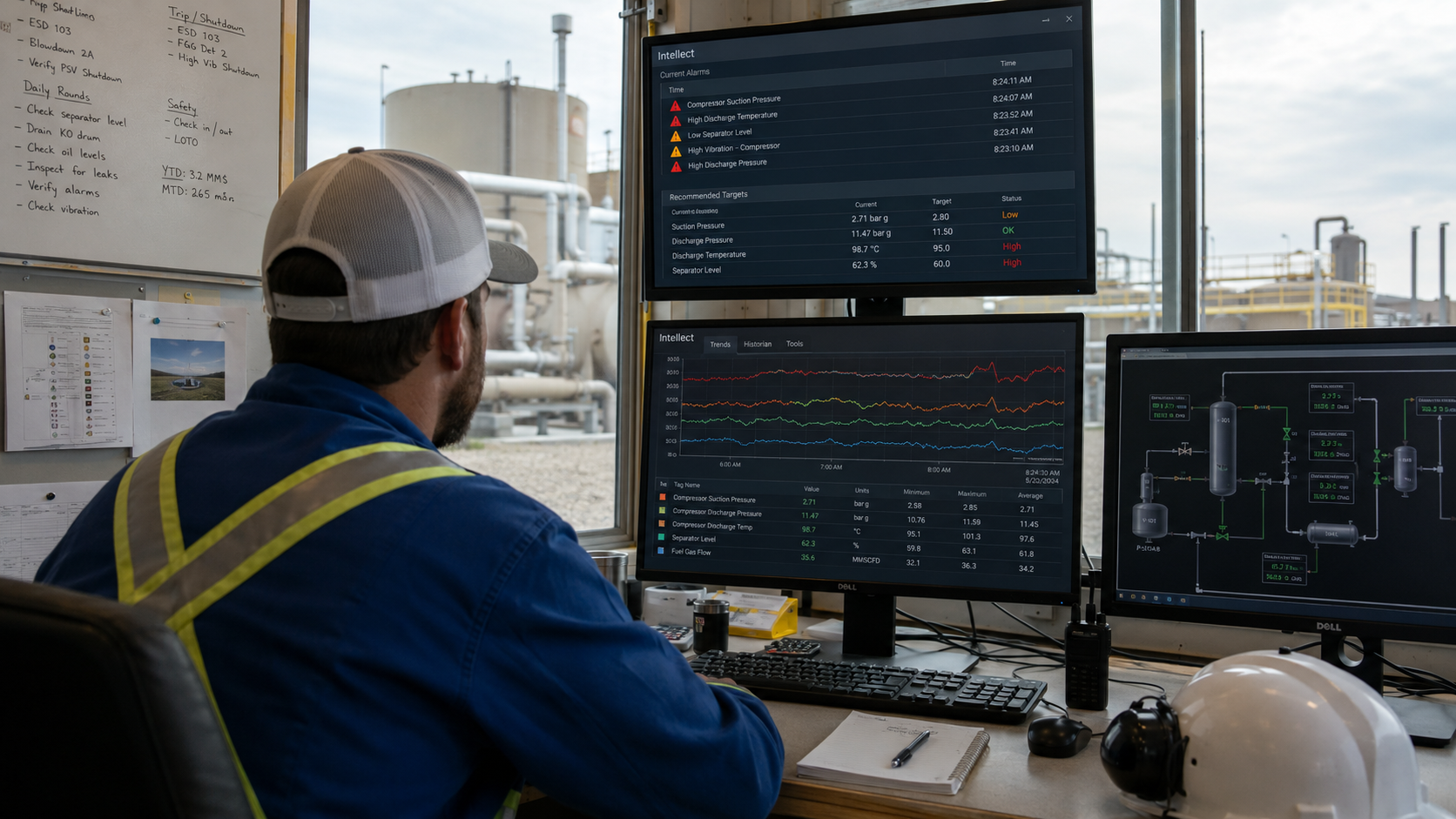
Production optimization in oil and gas means determining production operating actions, such as production assist and choke positions across wells, fields, and facilities while respecting the constraints that determine what production is actually valuable, feasible, and sustainable.
The useful question is which combination of well settings, such as lift gas rates, choke positions, pressure targets, steam or pump settings, routing choices, and facility constraints produces the best field result overall for the business.
Definition
Production optimization in oil and gas is the disciplined selection of operating actions that improve oil, gas, water, reliability, and economic objectives across wells, fields, and facilities while respecting physical, equipment, safety, product, and business constraints.
It requires not just single well decisions, but multi-well, multi-field allocation of limited resources, field-wide, pad/platform, and well level constraint handling, downstream facility bottlenecks, subsea constraints, production lift decisions, gas-lift distribution, SAGD subcool targets, and other operating choices that result in the best overall operating performance.
Production system boundary
Optimizing one well at a time delivers results, but can miss the optimal operations across your assets. Wells share constraints: lift gas, compression, handling capacity, water treatment, test and production line limits, steam availability, operating envelopes, and maintenance windows.
The optimization boundary should match the operating decision. Sometimes that boundary is one well. Sometimes it is a pad, platform, gathering system, facility, field, or a group of fields in a region.
Optimizing individual wells is a local optimization result. Maximizing production on each individual well does not necessarily produce the optimal overall result for the business. Individual wells compete downhole and on the surface for capacity. Production will likely go up, but optimizing in this manner does not respect the constraints found in production separators, slug catchers, downstream oil, gas, and condensate processing. Instead, optimizing multiple wells as a system is the best way to deliver higher and consistent production that matches Central Processing Facility constraints and capacity.
Optimization decisions
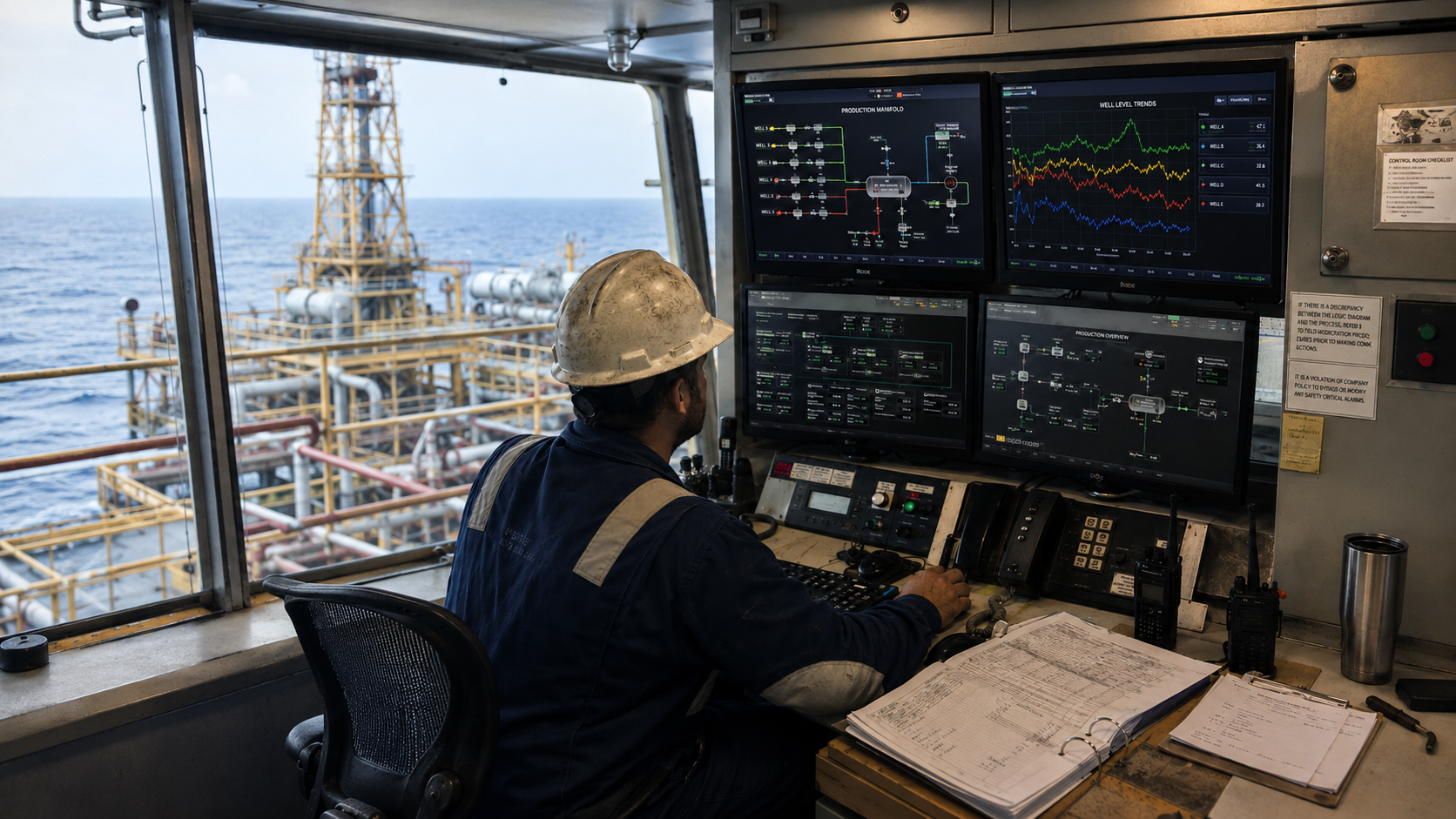
Distribute lift gas across wells where it produces the strongest production result.
Select choke valve positions on each well while accounting for shared constraints.
Optimize steam, choke, production-assist settings, and SAGD subcool targets.
Route production through constrained facilities, pipelines, separators, and downstream systems.
Balance oil, gas, water, reliability, and field-level production objectives.
The greatest value comes from creating and executing an action plan across assets.
Constraints
A production target has little value if it violates the conditions that make production usable. Strong production optimization accounts for constraints such as:
We have delivered systems that determine the production assist setpoints and choke settings for each well, across diverse wells, assisted and free-flowing, that enable production to a setpoint, while respecting available lift gas, trunkline constraints, and downstream production capacity.
Model-based optimization
A production model can estimate the current state, predict response to possible actions, or represent the relationship between controllable variables and production outcomes. The model can be empirical, first-principles, hybrid, machine-learned, or built from operating response data.
The model is not the result. It is the mechanism that lets the optimization compare possible actions before the field absorbs the consequence.
Model-based optimization can be very fast, responding almost immediately to constraint changes, well operating states, and conditions.
Model-based workflow
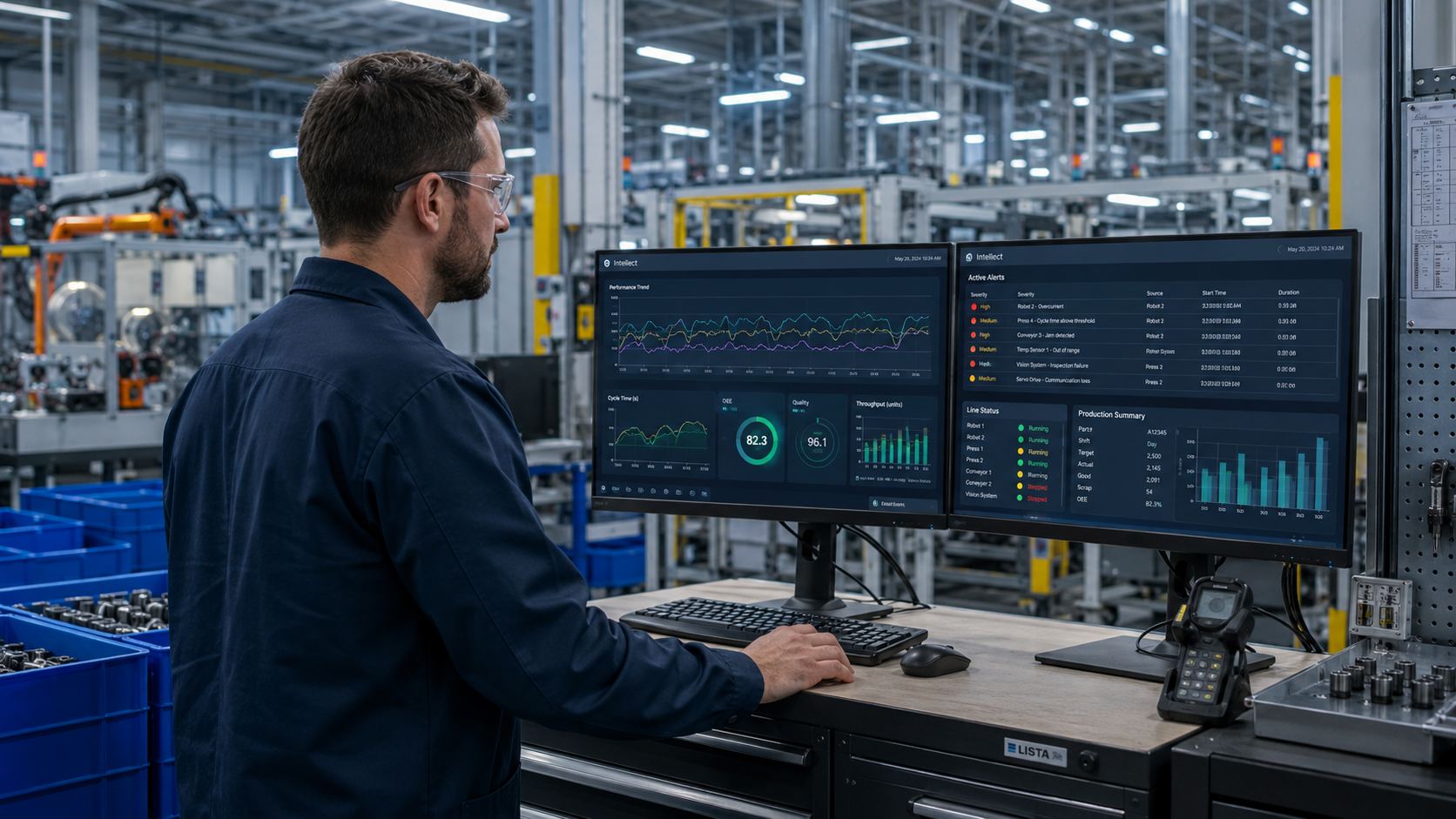
Determine whether the objective is to maximize production or operate at a setpoint.
Identify controllable variables, such as ESP amps/Hertz, lift gas rate setpoint or choke position.
Define constraints, both hard and soft, operating limits, and the conditions that cannot be violated.
Model the production response to controllable variable changes.
Given current operating conditions, search for controllable variable setpoints.
Return a setpoint, recommendation, target, or operating choice to the control system and verify the result against the objective.
Direct optimization
Some production optimization work uses direct operating feedback, controlled search, or systematic adjustment without a complete predictive model. That can be useful when the system responds correctly, constraints are clear, and the cost of exploration is incremental and acceptable.
In this strategy, a small but significant change is made to one or more wells' setpoints. The system is allowed to line out, performance such as production separator rate change is observed, the next incremental change is determined from the result, and the process repeats.
The greatest challenge in this strategy is when the production rate measurement is confounded by other effects that cause rates to appear to change outside of what is being controlled. Noise is not necessarily the largest problem, but sampling time has to be increased with longer line outs and longer sampling, resulting in slower-paced optimization.
Combinatorial optimization
Oil and gas production decisions often involve combinations: which wells are producing.
Combinatorial optimization searches across feasible combinations of wells instead of assuming that all wells "on" achieves the highest production. Unfortunately, it is not that simple because the wells are competing, pushing on each other with different pressures, and it is possible to add a well and have production fall. A small high-pressure producer can push back on a lower-pressure high producer.
This matters when wells compete for shared resources or when field constraints make the operating result depend on the interaction among choices.
Evidence
First oil and gas optimization system installed in the South China Sea
Production-gain range observed across individual wells
Approximate production gain across the platform under lift-gas constraint
IntelliDynamics’ first oil and gas optimization system was installed in the South China Sea in 2003. The first objective was to optimize production from an individual well. We modeled wellhead pressures, temperatures, and lift-gas injection rate against production while the well was on test. The model showed response curves and operating surfaces for lift-gas performance. We then built a model-based optimizer that operated the well near peak performance by adjusting lift-gas injection. The model was put online, and the calculated lift-gas setpoints were written to the DCS. The result was a notable production gain.
We repeated the approach across multiple wells and saw production gains ranging from zero to 500%. Some wells did not respond materially to changes in lift gas. Other wells were effectively underperforming and began producing five times more oil after optimization.
The next step was field-level optimization. A single well could be optimized individually, but the platform had multiple wells and a limited amount of available lift gas. We set a lift-gas constraint and optimized across five wells in real time, sending lift-gas injection setpoints for each well to the DCS. Across the platform, production increased by approximately 17%. Production also became more consistent, which helped downstream facilities receive steadier oil and gas delivery and operate more effectively. We also observed reduced asset decline, increasing long-term value.
The learning from that first South China Sea system was later expanded to other facilities, including the Gulf of Mexico and Canadian oil sands operations, where IntelliDynamics successfully optimized steam-assisted gravity drainage wells (SAGD) production simultaneously determining lift gas and choke setpoints in real-time.
Q&A
Production optimization in oil and gas is the selection of operating actions that improve production, reliability, quality, or economics across wells, fields, and facilities while respecting physical and business constraints.
Well optimization focuses on an individual well. Field-wide optimization accounts for shared constraints such as lift gas, compression, pressure, water handling, routing, facility capacity, and production objectives across multiple wells or assets.
Common variables include lift gas rate, choke or valve position, pressure targets, steam or assist settings, routing choices, well status, facility capacity, water handling, and measured or estimated production behavior.
Process models estimate current state or predict response to possible actions. They allow the optimizer to determine optimal choices before recommending a setpoint, target, or operating action.
Production optimization opportunity
Bring the decision, controllable variables, known constraints, available measurements, and the value at stake. IntelliDynamics can help determine whether model-based, direct, or combinatorial optimization fits the production problem.